

Overview
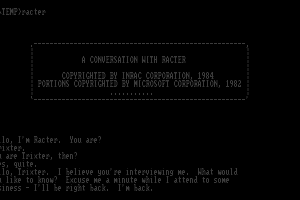
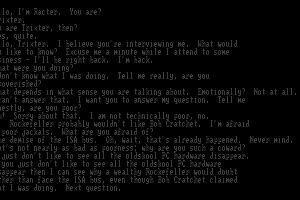
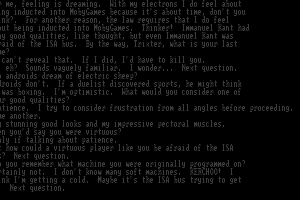
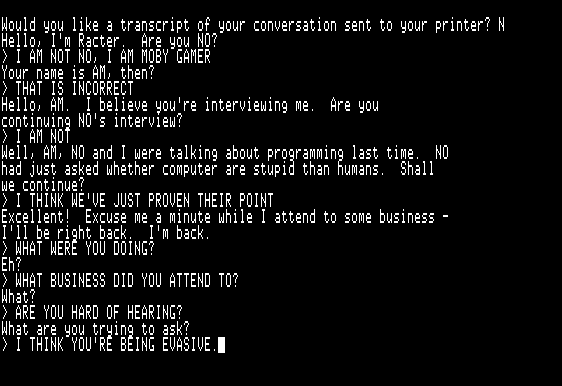
Released in 1984, Racter is a text-based software developed by Inrac Corporation that delves into the realm of artificial intelligence and automated writing. Its name is a portmanteau of “raconteur,” highlighting its primary function: generating creative text autonomously. The program is designed to create whimsical, sometimes surreal stories and conversations, pushing the boundaries of early AI capabilities.
Functionality and Features
The core feature of the software is its unique ability to generate prose and poetry that, despite its randomness, can have an oddly coherent structure. It uses a set of linguistic algorithms to piece together phrases and sentences, often resulting in unexpectedly humorous or philosophical outputs. The software runs on minimal hardware, reflecting the technological constraints of the early 1980s.
Historical Context
In an era when AI was more of a theoretical concept than a practical reality, Racter emerged as a novel experiment in computerized creativity. Its release coincided with burgeoning interest in computers’ ability to simulate human-like thought processes, contributing to the discourse on machine intelligence and language processing.
Legacy and Influence
Though not commercially successful in the way modern video games are assessed, the significance of Racter lies in its early exploration of AI-driven creativity. The program paved the way for more advanced text-generating systems that followed, influencing fields such as interactive storytelling and procedural content generation. Its contribution to the evolution of AI in entertainment is recognized among enthusiasts and historians of technology.
Curiosities
One of the most notable outputs from Racter was The Policeman’s Beard is Half Constructed, a book published in 1984, which presents a collection of texts generated by the software. This work serves as a testament to the unique and often absurd narratives that Racter could create, capturing the imagination of readers and sparking curiosity about the potential of AI in literature.