

DB Version: 1.0.1 - Last Update: 23/09/2025
SuperVision Games
SuperVision
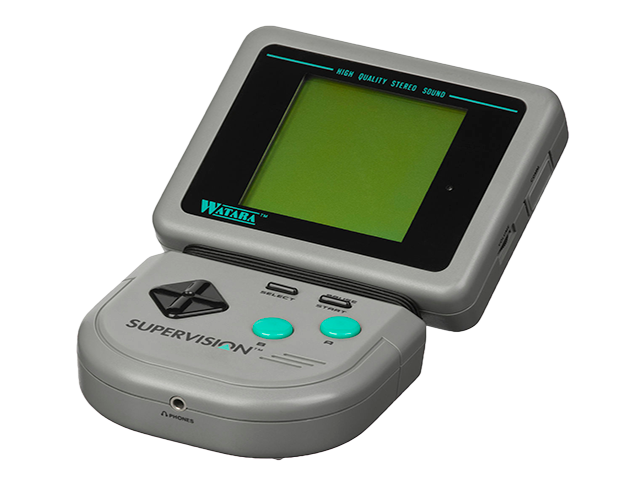
Year: 1992
Generation: Fourth
Producer: Watara
Launch Year: 1992
Discontinued: 1993
Units Sold: 2 milion
Top Game: Jungle Hunt
Price at Launch: $99
Country of Origin: Taiwan
CPU: 8-bit 65SC02
RAM: 2 KB
Devices / Peripherals: Game Cartridges,Link Cable,Power Supply
1. What Was the Watara Supervision?
The Watara Supervision, released in 1992, was a low-cost handheld gaming console developed in Taiwan as a competitor to Nintendo’s Game Boy. Distributed under various names and brands worldwide (including QuickShot Supervision and Hartung Supervision), it featured a larger screen and more open development — but fell short in quality, performance, and game selection.
Despite its limitations, the Supervision is remembered for its underdog charm and unique role in portable gaming history.
2. Key Features of the Supervision
- Monochrome LCD screen: 160x160 resolution — larger than the Game Boy but with poor contrast and ghosting.
- Custom 8-bit CPU: clocked at 4 MHz, with basic sound and simple graphics support.
- Cartridge-based system: inserted into the top, with region-free play.
- Tilt-screen variant: some models had adjustable screens for ergonomic play.
- TV-out support: rare feature for handhelds, allowing some models to connect to a TV.
3. Game Library and Software
- About 66 games released: most were simple arcade-style titles or puzzle clones.
- Notable games: Crystball, Galaxy Fighter, Chimera, and Hash Block.
- Lack of third-party support: limited developer interest hurt long-term viability.
4. Legacy and Collector Appeal
Though commercially unsuccessful, the Supervision became a cult item among retro collectors. Its clunky design and “so bad it’s good” library give it a nostalgic charm for enthusiasts of handheld oddities.
- Budget-friendly alternative: originally targeted at parents looking for a cheaper Game Boy.
- Collector’s curiosity: boxed units and rare games are now valuable in retro markets.
- Preserved via emulation: platforms like Mednafen and MAME keep the Supervision playable today.
GAMES SUPERVISION


© 2026 Don't think about what you see, but create what you imagine.