

DB Version: 1.0.1 - Last Update: 23/09/2025
Amiga Cd 32 Games
Amiga Cd 32
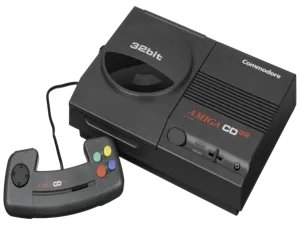
Year: 1993
Generation: Fifth generation
Producer: Commodore International
Launch Year: 1993
Discontinued: 1994
Units Sold: 100 000
Top Game: Alien Breed 3D
Price at Launch: 399-499 USD
Country of Origin: United States
CPU: Motorola 68EC020
RAM: 2 MB
Devices / Peripherals: Joypad
1. What Was the Amiga CD32?
The Amiga CD32 was a 32-bit CD-ROM-based video game console developed by Commodore and released in 1993. It was one of the world’s first 32-bit CD gaming systems and the first console to be based on the Amiga computer architecture.
While short-lived, the CD32 represented Commodore’s push into the growing home console market and served as a bridge between personal computing and living-room gaming.
2. Key Features of the CD32
- 32-bit architecture: based on the Amiga 1200 with an AGA graphics chipset and Motorola 68EC020 CPU.
- CD-ROM drive: allowed for larger games with full-motion video and CD-quality sound.
- Multimedia capabilities: supported CD audio, Photo CDs, and MPEG video (with add-on module).
- Expandable design: compatible with keyboard, mouse, floppy drives, and hard disks via third-party modules.
- Shared library: could run many Amiga 1200 games with minimal modification.
3. Market Challenges
- Limited support: struggled to attract third-party developers due to Commodore’s financial instability.
- Short lifespan: discontinued less than a year after launch as Commodore filed for bankruptcy in 1994.
- Regional release issues: released in Europe and Canada, but plans for U.S. expansion were cancelled.
- Controller quality: the included controller was often criticized for being cheap and unresponsive.
4. Lasting Influence
Despite its commercial failure, the Amiga CD32 holds a place in retro gaming history as a technically impressive but poorly timed console. It showcased what the Amiga platform could do in a simplified, console-ready format.
- Cult following: still loved by Amiga enthusiasts and collectors today.
- Rare hardware: original units and accessories are now highly sought after.
- Preserved digitally: many of its games live on through emulators and online archives.
GAMES AMIGA CD 32
Nothing Found
Sorry, but nothing matched your criteria. Please try again.
© 2026 Don't think about what you see, but create what you imagine.