

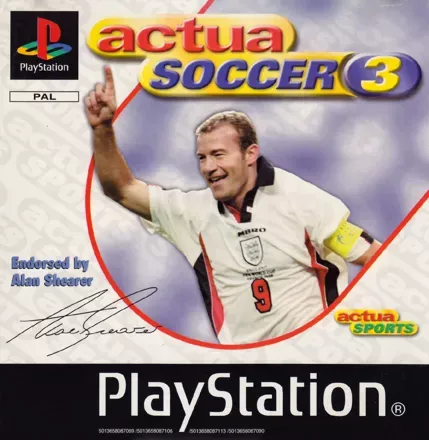
Historical Context & Trivia
Actua Soccer 3 (1998) is the final entry in Gremlin Interactive’s Actua Soccer series and one of the more ambitious late-1990s football simulations on the PlayStation. It arrived at a time when sports games were pushing for larger rosters, broader licensing-style authenticity, and more presentation polish, and this installment expanded the series with club and national sides, joke teams, and a notably large player database for its era.
Gremlin Interactive positioned the game as a full-scale football simulation rather than an arcade-style take, continuing the studio’s established Actua Sports identity. Contemporary database records and retro game listings place the PlayStation release in late 1998, with regional dating varying slightly by source, which is typical for PAL-era sports releases.
Gameplay & Technical Features
As a Sports title, Actua Soccer 3 centers on association football matches with a broad selection of teams, league-style structures, and the series’ simulation-first approach. The game emphasizes squad variety, match customization, and large-scale football content rather than exaggerated physics or fantasy mechanics.
On PlayStation, the game was built around the console’s strengths in 3D presentation and CD-ROM storage, allowing for a sizable roster set, commentary, and presentation assets. The audiovisual package was marketed with polished crowd effects and broadcast-style audio, while the PAL release was identified with the serial SLES-01644, a useful marker for collectors and preservation researchers.
Collector’s Value & Rarity
Actua Soccer 3 is not generally considered a rare marquee collectible, but it remains a desirable late-generation football title for PlayStation collectors, especially those focusing on complete series sets or European sports releases. Value tends to be driven more by condition, completeness, and regional demand than by extreme scarcity.
For collectors, the most important physical details are the PAL edition identifiers, regional packaging variations, and the presence of original inserts and manuals. As with many European PlayStation sports games, boxed copies are more common than sealed examples, so preservation interest usually centers on keeping the original case, disc, and printed collateral together.