

Historical Context & Trivia
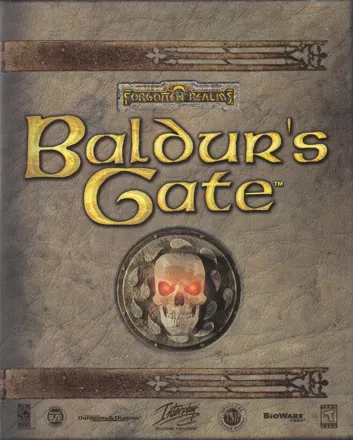
Baldur’s Gate (1998) arrived as one of the defining computer role-playing games of the late 1990s, helping reestablish the PC as a serious home for deep party-based fantasy adventures and becoming a landmark title in the modern Dungeons & Dragons lineage.
Developed by BioWare Corporation and published by Interplay Entertainment, it was built around the Forgotten Realms setting and a modified version of Advanced Dungeons & Dragons 2nd Edition, with the Infinity Engine giving the game its distinctive real-time-with-pause structure and isometric presentation.
Gameplay & Technical Features
This Role-Playing game centers on party management, tactical combat, exploration, dialogue choices, and character progression, blending tabletop-inspired rules with a computer-driven pace that rewards careful positioning and spell use.
On Windows, the game used an isometric 2D visual style, large-area environments, voiced and text-heavy narrative delivery, and a technical framework designed to handle expansive maps, detailed sprites, and a dense interface suited to mouse-driven play.
Collector’s Value & Rarity
Baldur’s Gate is not a rare title in the strict scarcity sense, but original late-1990s retail editions remain desirable because of the game’s historical stature, the survival rate of complete boxed PC copies, and demand from RPG collectors.
Value is typically shaped by whether the set includes original discs, manuals, inserts, and box art, with regional publishing differences and later reissues or enhanced editions making complete first-release Windows packaging more noteworthy to collectors.