


Overview
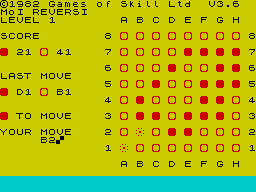
Released in 1983, this digital version of a classic board game aimed to capture the strategy and simplicity that has long been associated with its physical counterpart. Players take turns placing pieces on a grid, each move sandwiching the opponent’s pieces, which are then flipped to the player’s color. The game progresses as both players strategize to have the majority of their colored pieces on the board by the end of the game.
Gameplay Mechanics
The rules are simple yet offer a deep potential for strategic planning. The objective is to end the game with more pieces of your color on the board than your opponent. A valid move is one that brackets one or more of the opponent’s pieces between the piece being placed and another piece of the same color already on the board.
Significance
Though this version did not receive as much fanfare as more popular releases of its time, it stood out for successfully bringing a well-loved board game into the digital realm. This enabled the game to reach a broader audience, allowing enthusiasts to enjoy it on emerging computer platforms.
Technical Details
- Developer: Unknown
- Platform: Various, typical of the early 1980s home computer scene.
- Mode: Single-player against AI or two-player with shared controls.
Legacy
The digital adaptation from 1983 paved the way for numerous future versions, sustaining interest in this simple yet challenging board game. It demonstrated the potential of computer-based board games in a period where digital gaming was just beginning to define its identity.