

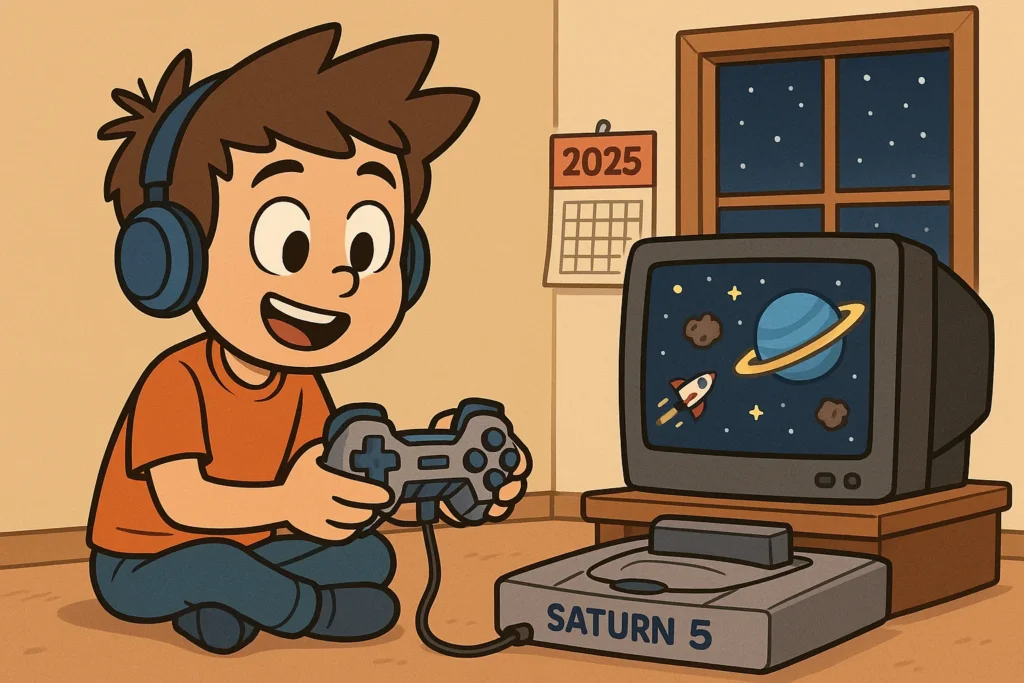
Summer 1994 I was 12 years old and fully immersed in the evolution of gaming consoles. I had always been a devoted PC enthusiast, growing up with the VIC-20, the Commodore, and later the 386. But that summer, my attention was completely captured by Sega’s console.
Maybe it was the name Saturn evoking one of the most fascinating planets we can admire even with a modest telescope. Maybe I just needed a change, a chance to explore what the world of consoles had to offer. Or maybe it was the allure of iconic titles like Daytona USA and Virtua Fighter, set to arrive in our living rooms on a powerful new gaming machine.
In hindsight, 1994 turned out to be Sega’s most difficult year. Sony burst onto the scene with its PlayStation: cheaper, easier to develop for, and backed by a phenomenal game library. It shattered the bright future once envisioned for Sega’s giant, a company founded by Martin Bromley and Irving Bromberg.
And yet, for reasons I can’t fully explain, my heart has always rooted for the Saturn. The next console Dreamcast was, in many ways, a vision of the future. A masterpiece that few buyers truly understood at the time. Sega had built a console ahead of its time, featuring a multiplayer system and raw power that was almost unheard of back then. But it was too advanced. We, the ordinary gamers, only came to appreciate its brilliance years later when the darkness had already closed in and Sega’s light had begun to fade.
I still believe the downfall shouldn’t have started with the Saturn. Perhaps it was a flawed marketing strategy. And I still believe Sega should be making consoles today, gifting us stories that make us dream again.
I like dreaming especially now, as white hairs begin to show, and I welcome them with a smile.