

Historical Context & Trivia
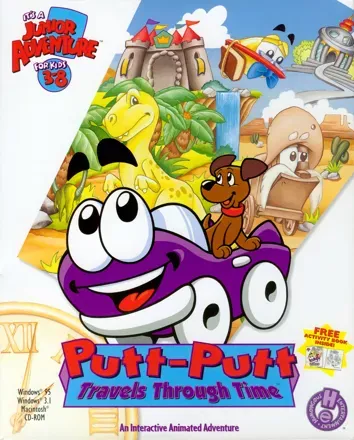
Putt-Putt Travels Through Time (1997) is a well-known Humongous Entertainment children’s adventure game that sits within the studio’s broader Putt-Putt series, a staple of late-1990s edutainment on home computers. Its time-travel premise and accessible point-and-click structure made it a recognizable entry in the company’s catalog for families and young players.
Humongous Entertainment handled both development and original publishing for the Windows release, which also appeared on Macintosh in the same era. Later re-releases expanded its footprint across modern storefronts and platforms, reinforcing its status as one of the more enduring titles from the studio’s Junior Adventures line.
Gameplay & Technical Features
This adventure game centers on simple inventory use, environmental interaction, character dialogue, and lightweight problem-solving designed for younger players. The structure emphasizes exploration over failure states, with puzzles presented in a low-pressure format that matches the series’ educational and child-friendly identity.
On Windows, the game was built for mid-1990s PC hardware and CD-ROM distribution, with animated presentation, voiced characters, and colorful cartoon visuals typical of Humongous Entertainment productions. Its audio-visual design followed the studio’s signature approach: bright 2D art, readable interfaces, and broad compatibility with the era’s consumer PCs.
Collector’s Value & Rarity
As a widely distributed retail PC title, Putt-Putt Travels Through Time is not generally considered rare, but boxed copies in complete condition can still attract interest from collectors focused on classic children’s software and preserved edutainment libraries. Value tends to depend more on completeness and condition than on scarcity alone.
Desirable copies are typically those that retain the original CD-ROM, manual, and packaging inserts, especially for Windows big-box releases. Regional publisher variations and later reissues exist, but the original 1997 retail presentation remains the most collectible form for preservation-minded buyers.