

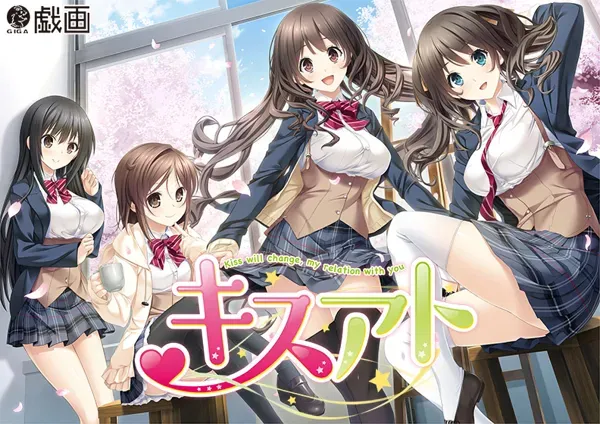
Historical Context & Trivia
Kiss Ato (2014) is a Japanese Windows romance adventure game from GIGA, presented as the third entry in its “Kiss” series after Hotchkiss and KisBell. It was originally released in Japan on 31 January 2014 and was positioned around an art-school setting with a contemporary relationship focus.
Available documentation identifies GIGA as the original developer and publisher, while later console and mobile adaptations were handled through other companies, including Entergram for later rereleases. The game’s subtitle is given in English as “Kiss will change, my relation with you,” which reflects the series’ emphasis on timing, intimacy, and everyday romantic progression.
Gameplay & Technical Features
Kiss Ato is an Adventure game built around character interaction, branching romance routes, and relationship-driven decision-making rather than action systems. Source descriptions place it within the visual-novel-style “communicative” romance subgenre, with multiple heroines and a school-life structure centered on social choice and progression.
On Windows, the original release targeted Japanese PC systems and was distributed as an adult-oriented title, with later platform versions adjusting content and presentation for their respective audiences. The setting emphasizes an arts-focused school environment, and the game’s design leans on illustrated character work, dialogue scenes, and a contemporary visual-novel framework rather than technical spectacle.
Collector’s Value & Rarity
Kiss Ato is best understood as a mid-profile Japanese PC eroge rather than a globally rare artifact, so its collector value is primarily tied to complete Japanese PC packaging and condition rather than broad international demand. The original 2014 Windows edition is the key preservation item, especially for collectors seeking the uncensored PC release before later platform revisions.
Known physical variants include the original Windows release and later console editions, with the game also appearing on PlayStation Vita, PlayStation 4, and Nintendo Switch through subsequent releases. For collectors, the most relevant distinctions are regional Japanese packaging, edition differences between PC and console versions, and whether the set includes original inserts and printed collateral from the first release.