

Historical Context & Trivia
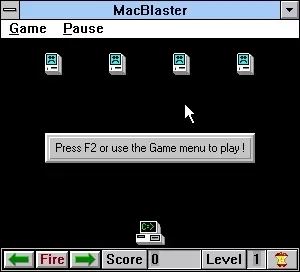
MacBlaster is a 1992 top-down action shooter for Windows 3.x, created at a time when graphical user interfaces and the so‑called “PC vs. Mac” debate were a prominent part of computer culture. It parodies this rivalry by casting the player as a PC defending its GUI against waves of Macintosh computers, visually and thematically echoing classic arcade shooters like Space Invaders while wrapping the gameplay in early‑90s tech in‑jokes.
The game is credited to Earl Gehr and is preserved today through historical software archives, but it never reached the visibility of commercial retail releases from major PC publishers of the era. Instead, MacBlaster circulated more as a small independent title, later becoming a curiosity in discussions of early Windows entertainment software. The generic labels “various distributors” and “expert designers” are not reflected in surviving primary sources; available documentation identifies a single named creator and does not list a formal publisher brand.
Gameplay & Technical Features
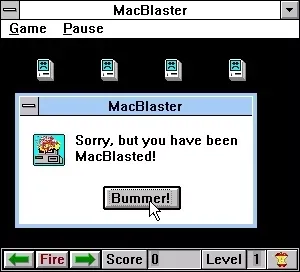
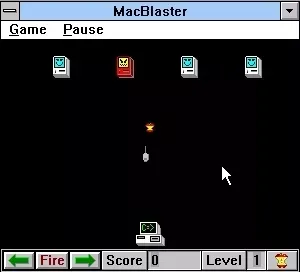
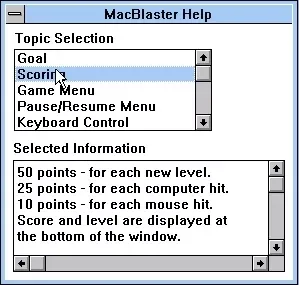
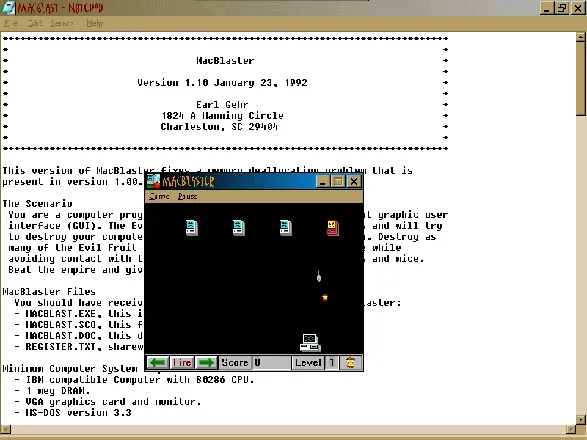
As an Action shooter with a strong arcade lineage, MacBlaster is built around a simple but escalating loop. The player controls a PC at the bottom of the screen, firing upward at incoming lines of Mac computers that advance in patterns reminiscent of fixed‑screen shooters. Destroyed Macs release descending “copyright bars” the player must either shoot or avoid, while enemy attacks take the form of thrown computer mice. The difficulty ramps by increasing speed and intensity from level to level, and the design is notably unforgiving: the player has only a single life, with any contact from enemy shots or falling bars resulting in immediate game over.
Running under the Windows 16-bit environment of Windows 3.x, the game demonstrates how early Windows titles adapted arcade conventions to a GUI‑based, mouse‑driven ecosystem. Graphics are presented in a straightforward top‑down 2D view, using icon‑like representations of PCs, Macs, and apples that fit the visual language of early‑90s Windows desktops. Sound and animation are modest by contemporary DOS arcade standards, but the appeal lies in seeing a classic shooter formula reimagined inside a multitasking windowed OS, at a time when most fast‑action games still targeted full‑screen DOS.
Collector’s Value & Rarity
From a preservation and collecting standpoint, MacBlaster is more of a historical footnote than a mainstream collectible grail. The game survives primarily through downloadable disk images and emulation in software archives rather than as a widely traded boxed product, reflecting its small‑scale distribution. Its value to historians and enthusiasts comes from illustrating how independent developers experimented with action games on Windows 3.x, rather than from high monetary auction prices.
Known releases of MacBlaster are typically found as bare software—single executable or shareware‑style package—without standardized retail packaging, printed manuals, or documented regional editions. As a result, there is little evidence of distinct box variants, localized releases, or branded collateral. For collectors focused on physical artifacts, any original floppies, registration cards, or documentation directly tied to Earl Gehr or an original distribution channel would be considered niche curiosities, but such items are scarce and not well cataloged in public databases.