

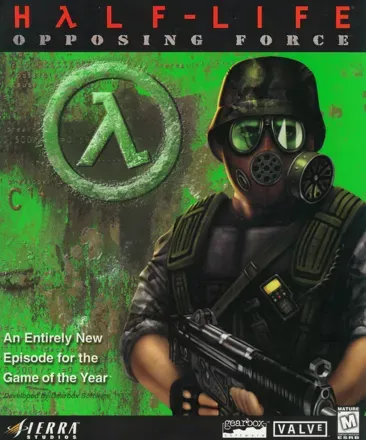
Historical Context & Trivia
Half-Life: Opposing Force was released in 1999 as the first official expansion for Half-Life, and it quickly earned a place in PC shooter history by recasting the original game’s Black Mesa disaster from the perspective of a U.S. Marine rather than Gordon Freeman. Its shift in viewpoint, new enemy types, and squad-based moments gave the expansion a distinct identity while still tying tightly into the larger Half-Life mythology.
Gearbox Software LLC developed the expansion under the supervision of Valve, with Sierra On-Line, Inc. handling publication for Windows. The project is especially notable because it demonstrated early confidence in third-party expansion development for a landmark FPS, and it became one of the most remembered add-ons of its era thanks to its polished design and strong fan reception.
Gameplay & Technical Features
As a first-person shooter, Half-Life: Opposing Force keeps the original’s action-adventure structure but adds new mechanics built around military survival, enemy variety, and limited squad support. Players control Adrian Shephard, navigating interconnected levels, using experimental weapons, and facing both familiar and newly introduced threats in ways that extend the original campaign rather than replacing it.
On Windows, the expansion runs on the same GoldSrc-era framework as the base game, which means its value lies in how well it adapts the existing engine rather than in radically changing it. The presentation follows late-1990s PC standards with keyboard-and-mouse precision, moody industrial environments, and the crisp sound design that helped define the original Half-Life experience.
Collector’s Value & Rarity
Half-Life: Opposing Force is not rare in the strictest sense, but original retail copies from 1999 remain desirable because they belong to one of the most respected PC shooter lineages of the era. Collectors tend to value complete, well-preserved editions with inserts and original media, especially when condition is strong and packaging remains intact.
Physical versions are most interesting when they include the original PC big box presentation, manual, registration materials, and any retail-era inserts associated with Sierra releases. Regional packaging differences exist across Windows releases, but the most sought-after examples are typically complete first-run copies with all original collateral present.