

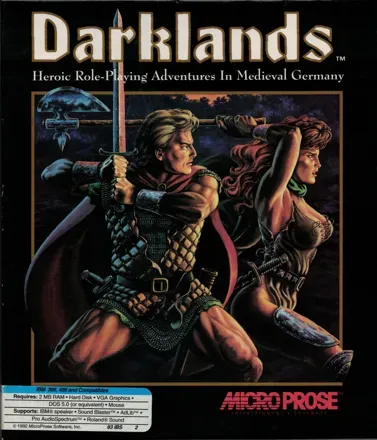
Historical Context & Trivia
Darklands was released in 1992 and is remembered as one of the most distinctive computer RPGs of its era because it grounded its fantasy in a historically inspired 15th-century Germany rather than in a generic invented world. Its setting, towns, currency, and day-night structure were built to evoke the Holy Roman Empire, while supernatural elements were filtered through medieval folklore and religious belief rather than high-fantasy convention.
The game was developed by MPS Labs and published by MicroProse Software, a company better known for strategy and simulation software than for role-playing games. Sources also note that it was MicroProse’s first and only CRPG, and that its design aimed for an unusually realistic medieval tone, including saints, alchemy, reputation, and historical flavor alongside monsters and magic.
Gameplay & Technical Features
Darklands is a role-playing game built around party-based exploration, questing, character progression, and reputation management. Players guide a group of adventurers across an open-ended map, taking on missions, visiting cities, and engaging in battles against both human and supernatural threats.
On DOS, the game used a top-down presentation and a dense simulation-style design that reflected the strengths and limits of early 1990s PC hardware. Its most notable systems included a lifepath-style character creation process, a time structure tied to canonical hours, and a visual and audio approach that emphasized atmosphere over spectacle, though contemporary accounts also note that the release was plagued by bugs and instability.
Collector’s Value & Rarity
Darklands has strong preservation value because it occupies a rare place in RPG history: it is both a cult classic and a technically ambitious experiment that influenced later open-ended fantasy design. Its reputation is also shaped by its difficult launch, since many retrospective assessments mention that MicroProse’s patches did not fully eliminate the game’s technical problems.
For collectors, the most desirable versions are the original DOS release materials and any complete boxed copies with manuals and period collateral, since those best reflect the game’s original presentation. Later reissues and modern digital releases help accessibility, but they do not carry the same physical appeal as an intact early-1990s MicroProse package tied to the game’s original release era.