




Overview
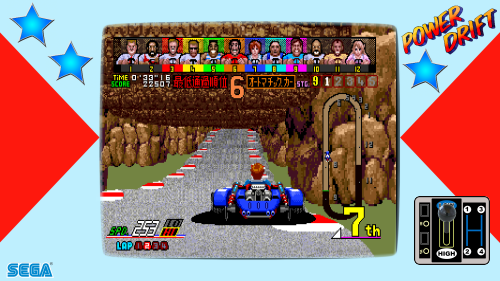
Released in 1988, this arcade racing game was developed by Sega and has distinguished itself with its innovative approach to the racing genre. Unlike traditional racing games of its time, this title introduced a unique dynamic gaming experience that captivated arcade goers around the world.
Gameplay
The game is set apart by its tilted perspective and the roller-coaster-like tracks. Players race against AI opponents across varying levels set in multiple environments, ranging from deserts to city landscapes. The arcade game used advanced sprite-scaling techniques to create a pseudo-3D visual effect, providing a sense of speed and complexity in track design that was cutting-edge for its time.
Technical Innovation
The cabinet featured a steering wheel, gear shifter, and accelerator pedal, delivering an immersive racing experience. Utilizing the Sega Y Board hardware, which was also used for Galaxy Force and G-LOC: Air Battle, the game achieved smooth scaling and rotation of the graphics, setting a new standard for visual performance in arcade games.
Historical Significance
While it may not have reached the iconic status of other Sega franchises, it holds a special place in arcade history for its innovative mechanics and presentation. It demonstrated Sega’s commitment to pushing technological boundaries, influencing the design of later racing games.
Legacy
Though it did not spawn numerous direct sequels, the legacy of this game can be seen in subsequent arcade racing titles that seek to recreate its high-stakes, dynamic gameplay. It’s remembered by gaming enthusiasts as a prime example of Sega’s creative prowess during the late 1980s.